The Future Is Vertical: Alisha Edwards’ Plan to Rebuild Baltimore from the Ground Up
Let’s Talk About Flipping the Narrative
West Baltimore has been hit hard—from redlining to the War on Drugs. But that doesn’t mean the story ends there.
Meet Alisha Edwards, a social entrepreneur on a mission to combine cannabis, food justice, and community power through the Baltimore Vertical Farming Association (BVFA).
What she’s building? It’s bigger than business. It’s a blueprint. “This isn’t just about cannabis—it’s about creating something sustainable for us, by us,” said Edwards when asked about the BFVA.
From the Industrial Past to a Greener Future
Alisha isn’t new to the city. A self-proclaimed history buff, she’s lived in the DMV for years and always felt connected to Baltimore and the legacy of Black excellence that thrived in places like Pennsylvania Avenue before policies like the War on Drugs gutted it.
“I’ve always looked at Baltimore and thought about what it was 100 years ago,” she says. “Before the War on Drugs, it was a hub for Black wealth, HBCUs, and small businesses.”
Now? The potential is still there. And Alisha sees a way to tap back in. A green way.
Enter the BVFA
The Baltimore Vertical Farming Association is what happens when vision meets action. Alisha brought 20+ years of experience in corporate America—including stints in tech, healthcare, nonprofits, and the cannabis industry—into a single mission: grow more than plants.
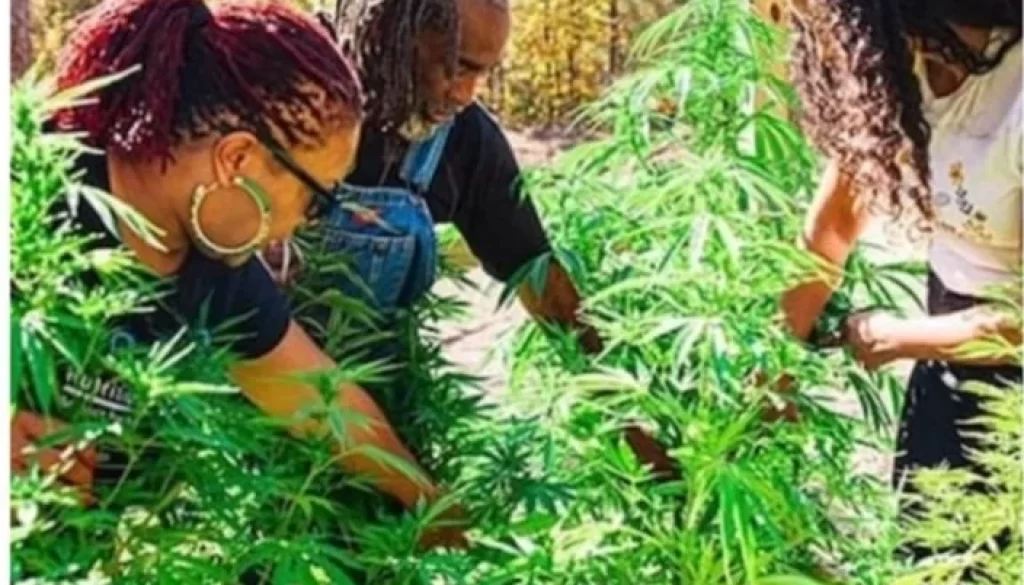
The concept: use cannabis as a cash crop to financially sustain vertical farms growing food, herbs, and hemp in areas where access is limited and opportunity is overdue.
“Controlled-environment farming isn’t cheap,” said Edwards. “But cannabis can fund the rest—vegetables, herbs, and even industrial hemp.”
To test her theory, Alisha flew to the Netherlands to study one of the largest indoor farming operations in the world. There, she witnessed how the Netherlands feeds its entire population with indoor-grown food. Make note, the entire country is the size of Maryland. Creating a smaller-scale model in West Baltimore seems more and more like a feasible thing to do.
“We’ve got the space. We’ve got the people. What we need now is the political will and community buy-in.”
So she’s turning abandoned warehouses into vertical grow sites. Cannabis for revenue. Hemp for clothing and hempcrete. Fresh produce to fight food apartheid.
Don’t Call It a Trend—It’s a Movement
Vertical farming isn’t new. Neither is weed. But the way Alisha is connecting the dots—cannabis, co-ops, food sovereignty, and workforce development? That’s movement work.
“This ain’t about recreating the wheel—it’s about finally driving it ourselves.”
Still, not everyone sees it that way. Especially in older communities where the trauma of the crack era still lingers, cannabis can be a trigger. She can empathize. ““I get it. But West Baltimore has looked like this my entire life,” Alisha says. “The liquor stores on every corner, the poverty. To not even consider cannabis as an alternative blows my mind.”
And that’s why she’s committed to coalition-building across generations. Because some folks just need to see it to believe it.
Plugging in the HBCUs, Planting Workforce Seeds
With Morgan State and Coppin State in the backyard, Alisha sees a real chance to make Baltimore a hub for cannabis and agricultural research, innovation, and Black excellence.
She’s already connected with the Office of Social Equity to explore how HBCUs can use their resources to train the next wave of growers, scientists, and policy shapers.
“I think about Booker T. Washington at Tuskegee. He knew the value of industry in building self-sufficient Black communities. That’s the mindset we need.”
The next big move? Workforce development and reentry programming for people impacted by cannabis convictions—especially after Governor Wes Moore pardoned over 175,000 low-level offenses.
“It’s not just about pardons,” Alisha says. “It’s about what happens after the pardon. People lost decades. We need to help them get skills and rebuild.”
A Final Word from Alisha (and from Us)
It’s taken patience. Persistence. And a whole lot of faith.
“This idea’s been in my head for over a decade,” she says. “But the time is now. We have a small window to get this right—for us, by us.”
If Baltimore can become a cannabis hub, it won’t just be for weed. It’ll be for wealth, wellness, and real change.
Wanna plug in? Visit baltimoreverticalfarms.org or follow @baltimoreverticalfarms on IG.